Skip to content

NCLEX-RN · 1,200 questions

Know why every answer is right.

1,200 questions across the whole NCSBN test plan, each with a rationale written and reviewed by practising nurses — and a readiness score that moves after every session.

Start free →50 free questions · No card needed
1,200
questions across all eight test-plan categories
Next Gen
case studies, matrix, bowtie and SATA
3 RNs
write and review every single item
A nursing student in scrubs working through NCLEX practice questions at her desk, a study plan on the whiteboard behind her

The loop

Identify your gaps and know exactly
what to work on next.

Answer
Question 6 of 75
A client 2 days postop following a total hip arthroplasty reports sudden dyspnea, pleuritic chest pain, and tachycardia. What should the nurse suspect?
A.Myocardial infarction
B.Pulmonary embolism
C.Postoperative pneumonia

Readiness score

Watch your readiness climb, not just your accuracy.

One number that reflects how ready you actually are for exam day — updated after every session, broken down by the areas NCLEX weighs most.

Overall Readiness
78%
↑ 12% this week
You’re trending ahead of pace for your target test date. Keep the streak going.
Pharmacological & Parenteral Therapies
84%
↑ 6%
Management of Care
76%
↑ 3%
Safety & Infection Control
72%
↓ 2%
Physiological Adaptation
61%
↑ 9%

Rationales

See the “why” behind every answer.

Q. A nurse is caring for a client who is 2 days postoperative following a total hip arthroplasty. The client suddenly becomes anxious and reports shortness of breath and pleuritic chest pain. Assessment reveals: HR 124/min, RR 30/min, BP 98/62 mmHg, SpO₂ 88% on room air.Which action should the nurse take first?
A · Incorrect
Administer the prescribed PRN anxiolytic.
Treats the symptom of anxiety, not the cause. Sedating the client can mask worsening hypoxia and delay recognition of a life-threatening event — never treat anxiety first when vitals suggest a physiologic emergency.
B · Correct
Apply supplemental oxygen and notify the provider immediately.
Sudden dyspnea + pleuritic pain + tachycardia + hypoxia after immobility is the classic pulmonary embolism triad. Airway/breathing come first (ABCs): stabilize oxygenation, then escalate for imaging (CT-PA) and anticoagulation.
C · Incorrect
Reposition the client to the left lateral Sims’ position.
This is the correct positioning for a suspected venous air embolism, not a PE — a different diagnosis with a different mechanism. Applying it here delays oxygen and provider notification without addressing the actual clot.
D · Incorrect
Encourage the client to use the incentive spirometer.
Useful for preventing atelectasis and pneumonia postoperatively, but far too passive for an acute hypoxic emergency — it does nothing to correct the SpO₂ of 88% right now.

Question types

Built around how NCLEX actually tests you.

❮Single Select MCQ1 / 10
Which action should the nurse take first?
Assess the client's vital signs
Notify the provider immediately
Administer the scheduled medication
Document the finding and reassess later
Prepare from anywhere, anytime

The smarter way to prepare for NCLEX.
In your space, on your time.

Access high-quality practice, track your progress, and get exam-ready—anytime, anywhere.

Learn on your time
Study whenever it fits your schedule.
Any device
Seamless experience across all devices.
Pick up where you left off
Your progress is always saved.
A nurse in scrubs reviewing questions on her phone outdoors with a coffee
On a break
A nurse working through questions on a tablet in a café
Between shifts
A nursing student annotating questions on a tablet at home
Before bed
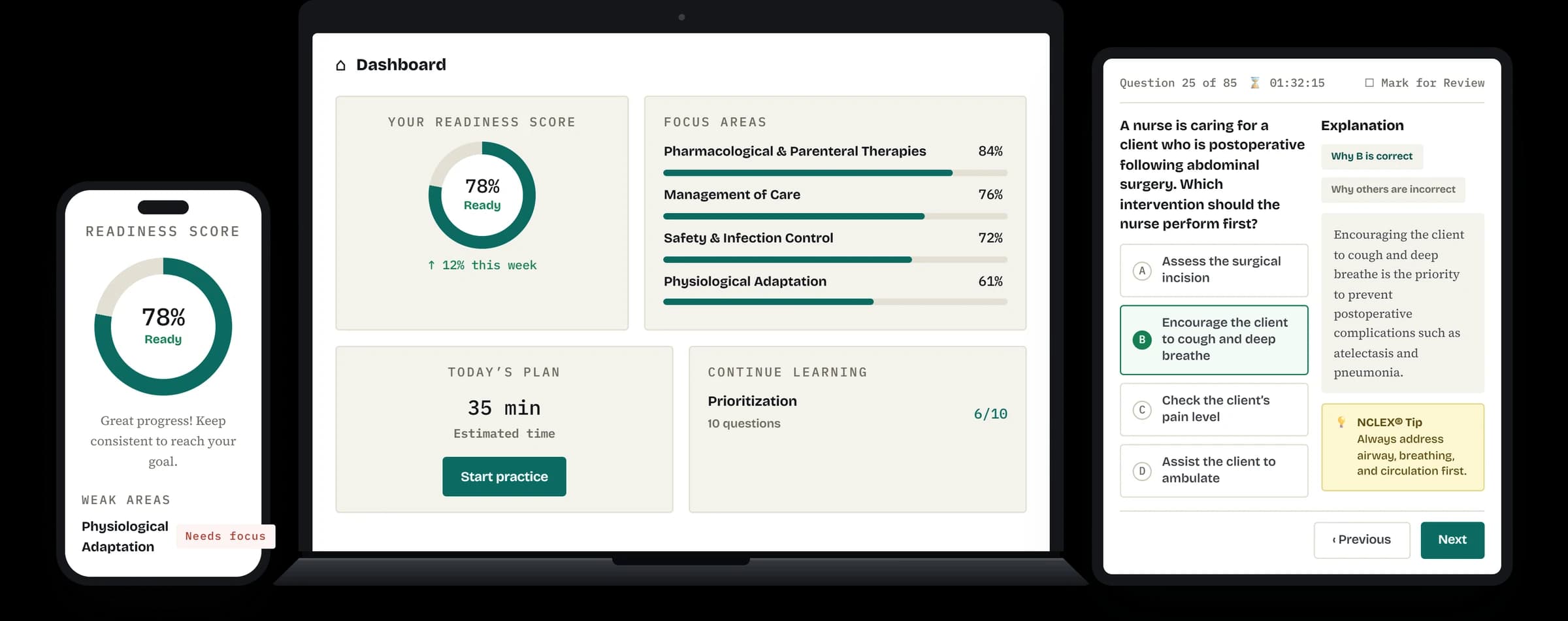
Nursia on a phone, a laptop and a tablet: a readiness score of 78%, a dashboard of focus areas by category, and a question showing why one answer is right and the others are not.

Questions people ask first

Before you sign up.

Are the questions really free?

Two hundred of them are, on the practice page, with no account at all. A free account adds 50 more across every category and keeps your progress, and it never asks for a card.

Who writes the questions?

Practising registered nurses write every item, and two more RNs review each one against the NCSBN test plan before it goes live. Names and credentials are on the about page.

Are these Next Generation NCLEX questions?

Yes — unfolding case studies, matrix, bowtie, and select-all-that-apply items alongside standard single-answer questions, matching the exam as it has been since April 2023.

What is the readiness score?

One number for how ready you are, weighted the way the NCSBN test plan weights each category rather than by raw accuracy. It moves after every session and breaks down by category, so it tells you what to study next.

Does it work on a phone?

Yes. The whole thing runs in a browser on a phone, tablet, or laptop, and your progress follows you between them. There is no app to install.

How long do I need to study?

Four to six weeks at around 90 minutes a day covers most candidates coming straight out of school. Our 4-week plan lays out what to do each week.

Can I cancel, and do you refund?

Cancel any time from account settings in one click, and access runs to the end of the period you paid for. Refunds are 14 days, no questions asked, processed the same day.


More on the exam itself in the guides, or on pricing.

Join 12,000+ NCLEX-RN aspirants and RNs

50 free questions. No card.

Start free →Cancel anytime